
Choosing the right school bag or backpack is important, but adjusting it correctly is just as essential.
How should you adjust a school bag to make the most of its ergonomic design and ensure healthy and comfortable carrying for your child? We have prepared a simple guide on how to properly adjust a BAAGL school bag or backpack, adapt it to your child's height and distribute school supplies correctly inside.
How to Properly Adjust a School Bag or Backpack
1. Adjusting the Back System
- For models with an adjustable back system (e.g. ERGO ADJUSTABLE SYSTEM), select size S, M, L or XL according to your child's current height.
- For back systems with a threaded Velcro strap (e.g. GROW SYSTEM), thread the strap under three crossbars and pull it back out below the number corresponding to your child's height in centimetres (marked with an arrow).
2. Organising the Contents
- Place the heaviest items as close to the back as possible, ideally in the compartment next to the back panel of the school bag.
- Use the side compression straps to pull the contents of the backpack as close to the body's centre of gravity as possible.
3. Correct Position of the Bag
- Always place a school bag filled with school supplies over both of your child's shoulders.
- The ideal position of the bag on your child's back is between shoulder level and the pelvis.
4. Shoulder Straps
- To position the bag correctly on your child's back, tighten both shoulder straps evenly by pulling them downwards.
- Always adjust the shoulder straps symmetrically and to the same length. This will bring the bag into the correct position while distributing the load evenly.
- Once the straps have been tightened, there should be no more than enough space to fit the palm of your hand between the bag and the lower back.
- When tightening the straps, also make sure that your child can move their arms freely.
5. Load-Lifter Straps
Use the shorter straps in the upper back and neck area to pull the school bag or backpack closer to the body. Adjust them evenly on both sides to prevent unnecessary strain on the spine and headaches.
6. Chest and Hip Straps
- Fastening and tightening the chest and hip straps helps stabilise the bag on your child's back and reduce the load.
- The chest strap can be moved vertically into the optimal position. Again, make sure it is adjusted symmetrically.
7. Correct Carrying
Always make sure your child wears their school bag or backpack over both shoulders. Carrying it on one shoulder causes an asymmetrical load and can lead to poor or even scoliotic posture.
8. Tip for Parents
- Teach your child how to adjust their school bag correctly.
- Make sure the straps are tightened regularly and that the heaviest items are stored as close to the back as possible.
Get the most out of BAAGL – your child's back will thank you.
Adjusting the Back System According to the Type of School Bag or Backpack
Some BAAGL models feature adjustable back systems that allow the school bag or backpack to be continuously adapted to your child's height as they grow.
ERGO School Bag
Adjust the ERGO system to your child's height so that the top edge of the school bag is level with their shoulders and the lower part rests against the lumbar area.
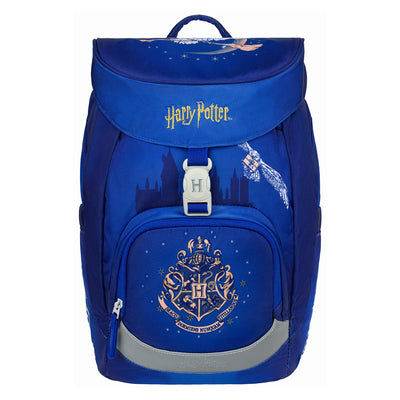
ZIPPY School Bag
With the ERGO ADJUSTABLE system, thread the Velcro strap from top to bottom according to the marked sizes.
To set size XL, thread the strap from the first upper crossbar through at least three sections to ensure maximum stability. For smaller sizes, follow the same procedure, but start one crossbar lower for each size.
AIRY PLUS
With the GROW system, thread the Velcro strap from top to bottom through at least three crossbars.
Start at the position corresponding to your child's size (S, M or L), thread the strap through and pull it back out at the point marked with an arrow indicating your child's height in centimetres.
ZIPPY PLUS
With the GROW system, thread the Velcro strap from top to bottom through at least three crossbars.
Start at the position corresponding to your child's size (S, M or L), thread the strap through and pull it back out at the point marked with an arrow indicating your child's height in centimetres.
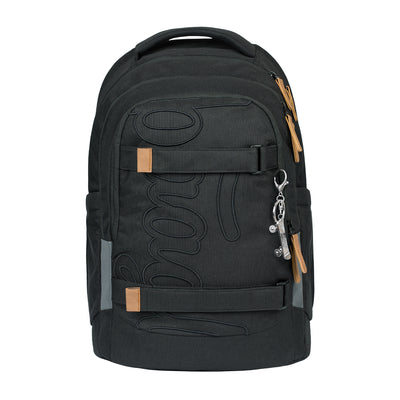
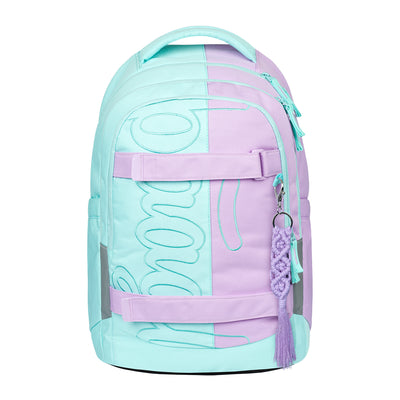
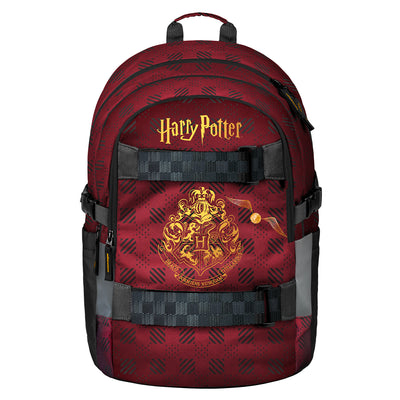
SKATE MAX Backpack
Thread the strap from bottom to top. Start at the letter corresponding to your child's size.
For maximum stability, thread the strap through at least three sections and pull it back out at the point marked with an arrow indicating your child's height in centimetres.
How to Attach BAAGLies Correctly
Do you have a school bag or backpack with interchangeable BAAGLies patches and are not sure how to attach them correctly? It's easy.
First, thread the Velcro strap underneath the stitched loops on the front pocket or flap of the school bag or backpack. Then attach your chosen BAAGLies patch to the threaded section of the Velcro strap.
The patches can then be easily swapped and combined depending on your child's mood or current interests.
The Most Common Mistakes When Carrying a School Bag
Even a correctly adjusted school bag or backpack may not perform its function properly if your child does not wear it correctly. What should you pay particular attention to?
- Carrying the bag on one shoulder. A school bag should always be worn over both shoulders. Carrying it on one side leads to uneven strain on the body.
- Shoulder straps that are too loose. The backpack will not sit properly against the back.
- Unevenly adjusted straps. The bag tilts to one side and the load is not distributed symmetrically.
- Unfastened chest or hip strap. If the model is equipped with these straps, they help pull the bag closer to the back and reduce the load.
- Heavy items too far away from the back. The heaviest school supplies should always be stored as close to the back as possible.
- Unnecessarily heavy contents. Regularly check whether your child is carrying items they do not need at school.
- An adjustment your child has outgrown. As children grow, the back system and straps should be checked and readjusted regularly.
What Does the Physiotherapist Recommend?
Physiotherapist Iva Bílková from FYZIOklinika also highlights the importance of correctly adjusting and carrying a school bag. BAAGL has been working with FYZIOklinika for many years on the development of ergonomic school bags and backpacks.
"We need to make sure the straps are adjusted correctly and teach children that they should always use them to pull their school bag or backpack firmly against their back," explains Iva Bílková. She adds that it is equally important to make children aware of the risks associated with bad habits, such as carrying a school bag on one shoulder.
"Carrying a backpack on one shoulder creates an asymmetrical load, which can result in poor posture and subsequently a scoliotic posture. Prolonged poor and scoliotic posture can lead to damage to the vertebrae and the development of scoliosis itself. These problems can follow a child into adulthood and may lead to migraines or herniated discs."
Iva Bílková, Physiotherapist, FYZIOklinika
Teach Your Child to Adjust Their School Bag or Backpack Independently
Correct adjustment should not be the responsibility of parents alone. Show your child how to tighten the shoulder straps correctly, how to use the chest and hip straps and where to place the heaviest textbooks.
This will allow your child to adjust their school bag or backpack independently throughout the day while developing good habits for everyday carrying.
Check the settings regularly and adjust them as your child grows. A well-chosen and correctly adjusted school bag goes hand in hand with healthy and comfortable carrying.